Context
Free Lossless Audio Codec (FLAC) is the standard of choice for lossless digital audio archiving. Managing a high-fidelity music library, however, involves more than just storing files; it requires maintaining consistent loudness levels, keeping metadata organized, identifying duplicate tracks, and ensuring underlying file structures remain intact over time. While modern audio players can play most files seamlessly, they do not provide the tools needed to detect audio duplicates, apply precise volume normalization, or verify low-level structural integrity across large collections.
Challenge
The goal was to build a reliable command-line utility in Python to automate the auditing and maintenance of FLAC music archives. The utility needed to inspect the internal binary structures of FLAC files according to the official RFC 9639 specification. Additionally, the tool had to perform safe re-encoding for corrupted files, calculate acoustic loudness normalization (ReplayGain), and generate readable, high-performance reports that scale to thousands of audio tracks.
Approach
To achieve reliable validation and repair, the implementation was structured around low-level file structure inspection and parallel execution:
- RFC 9639 Compliant Binary Parsing: developed a custom binary parser in Python to read FLAC’s structured metadata blocks, starting with the mandatory
STREAMINFOblock. The parser checks the Cyclic Redundancy Check (CRC-8) of the first audio frame and validates the MD5 checksum against the calculated signature of the audio stream to detect physical corruption. - Acoustic Loudness Normalization: integrated the EBU R 128 loudness standard using
pyloudnormto calculate ReplayGain values. The utility writes these standard metadata tags to files using themutagenlibrary at both track and album levels. - Isolated Automated Repair: created an automated workflow that identifies structural errors, moves corrupted files to a secure quarantine directory, and invokes the official
flaccommand-line encoder to safely re-encode and replace the files. - Fingerprint-Based Duplicate Detection: implemented a deduplication algorithm that groups duplicate files based on their calculated audio MD5 signatures, allowing users to identify identical recordings regardless of filename, directory, or metadata differences.
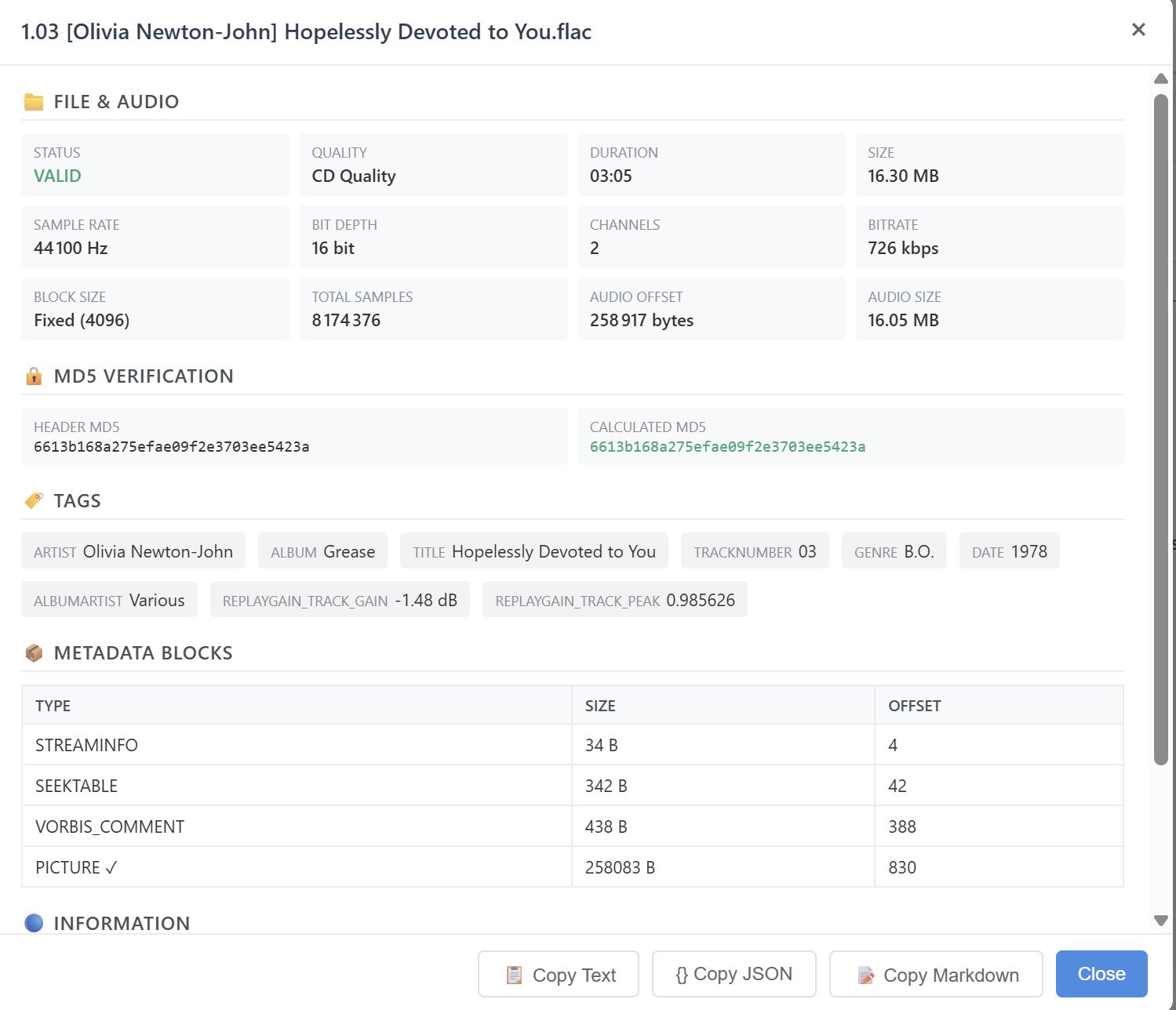
- Dual-Format Diagnostic Outputs: built a multi-format output engine. Validation runs write detailed machine-readable JSON files and compile an interactive HTML report featuring client-side filtering, sorting, and metadata extraction.
Features
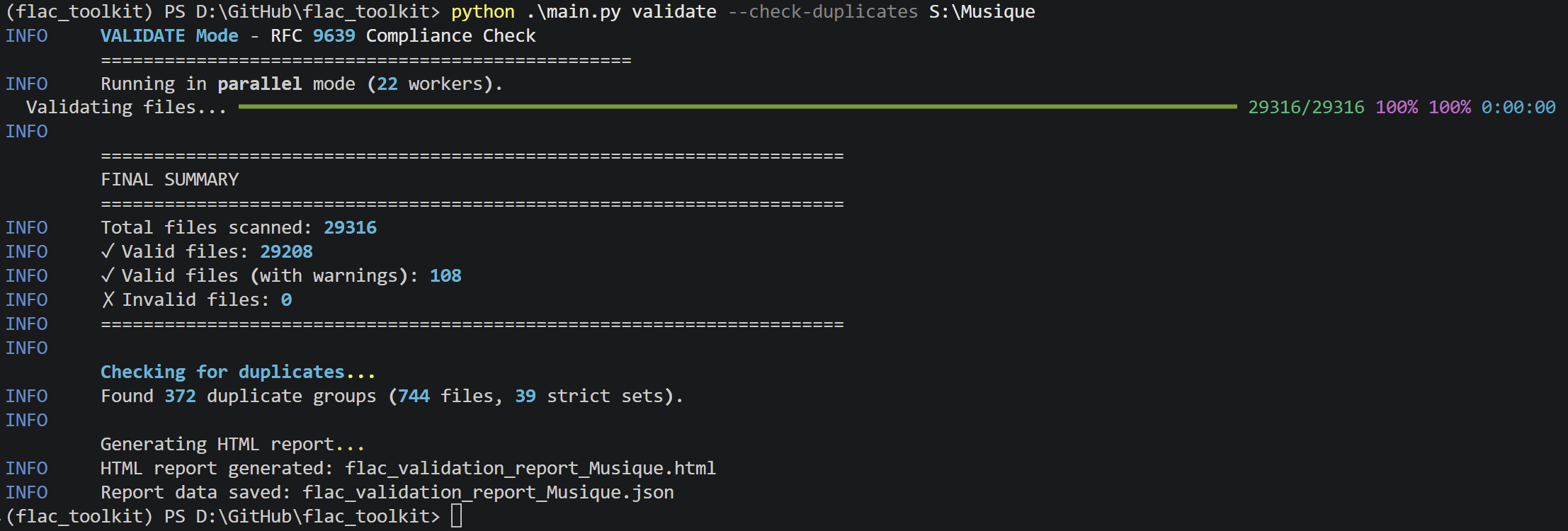
The FLAC Toolkit provides several modular features designed for automation and system integration:
- Command-Line Interface (CLI): a robust terminal interface powered by
richproviding colored logs, status summaries, and instant arguments validation. - Multi-Core Validation: validates individual files or entire directories recursively using parallel processing workers (
-w/--workers) to scale performance. - File Integrity Classification: automatically flags files with one of three status levels:
VALID,VALID (with warnings)(e.g., for oversized PADDING blocks), orINVALID. - Automated Quarantine & Repair: re-encodes structurally corrupted files using the native
flactool (with fallback toffmpeg) while maintaining the original filenames and isolating old files. - EBU R 128 ReplayGain Calculation: calculates track and album-wide loudness parameters to write compliant tags, ensuring consistent volume during playback.
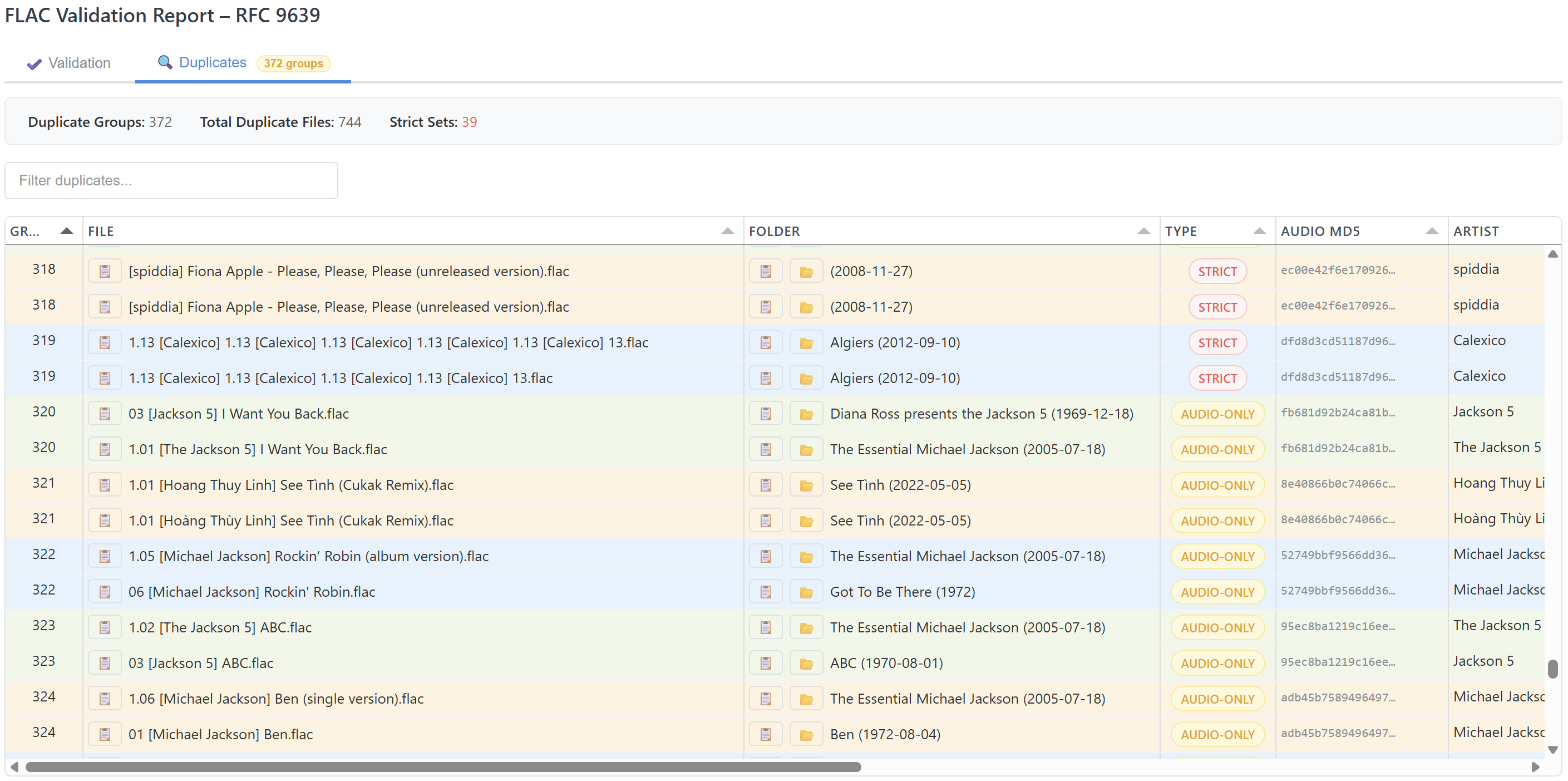
- Dual-Pass Audio Deduplication: identifies identical audio streams using MD5 checksums, distinguishing strict byte-by-byte duplicate files from audio-only duplicates (same audio, different tags) using SHA-256 validation.
- Tabulator-Powered HTML Reports: generates responsive, high-performance HTML reports containing a detailed dashboard and dedicated duplicates viewer, rendering thousands of entries smoothly using Virtual DOM.
- Workflows Reusability (
reportmode): exports all scan metadata as raw JSON data, enabling users to regenerate the interactive HTML reports instantly without repeating resource-intensive audio scans.
Outcome
- Scalable Collection Auditing: provides a reliable method for scanning and certifying multi-gigabyte audio archives, ensuring long-term digital preservation.
- Maintenance Automation: replaces manual checking and command chaining with a unified utility that automates file inspection, backup, and re-encoding.
- Optimized Data Analysis: generates lightweight JSON exports and high-performance HTML dashboards that allow archive managers to query and export library metadata efficiently.
- Standardized Interoperability: ansures all archived files strictly conform to the RFC 9639 standard and the EBU R 128 loudness specification, maximizing compatibility across high-fidelity hardware and software players.